
Chances are your company’s AI strategy is 3 executives who went to a conference and came back bewildered, anxious and slightly terrified. Point being, we’re early. How early?
You’ve Seen This Movie Before (You Just Don’t Know It)
Pundits throw "platform shift" around like business cards at a networking event where everyone's unemployed, but what's really shifting? It’s the office party moving from the conference room to wherever the free pizza is. The center of influence follows the resources. Miss the memo, and you’re left negotiating your budget with a decorative fern.
We pretend platform shifts began with Zuckerberg’s hoodie, but squint through history and you’ll see they’ve been compounding since the steam engine. Each one building on top of the previous generation, unlocking new capabilities:
Steam engines multiplied human muscle → Electricity took that power and distributed it everywhere → Computers said 'great, now let's process information with it.' → The internet connected those computers → Mobile shrank the connection to pocket size → Cloud gave that pocket infinite memory.
Now AI is taking all of it — the power, the distribution, the processing, the connection, the portability, the storage — and adding intelligence.
The pattern is predictable: each layer happens faster than the last, captures more value than the last, but weirdly, never kills the last. We still burn coal (steam's legacy). We still pay electric bills. Dell still sells computers. But buying Dell stock in 2025 feels like investing in pagers: technically functional, emotionally catastrophic.
That’s the thing about platform shifts - the old ones become utilities, while the new ones become the frontier of value and opportunity. Which brings us to the great paradox of our moment: The AI transformation will be long. But your advantage window is short. The enterprise will move cautiously. So people who quietly build fluency before the policies arrive will look like magicians.
Plot Twist: You're Already Technical Enough
So here you are, watching this AI platform shift like it's a foreign film without subtitles. Every day there's new headlines about ChatGPT writing code, generating art, passing medical exams. And yet you're sitting in the same conference room, staring at the same budget spreadsheet, having the same conversation about Q3 headcount like it's 2019.
Here’s what nobody’s telling you: A technologist isn’t someone who works in tech. It's someone sitting in any meeting, in any department, thinking, "there's got to be a better way to do this".
You could be in HR, drowning in resumes. In Finance, building your 47th Excel model. In Marketing, writing the same campaign brief for the third time this week. That nagging feeling? That's your technologist instinct. The gap between you and the person automating their entire workflow isn't talent — it's Tuesday.
AI is the most democratic technology to ever exist. Think about it: Back in ‘95 you needed a dial-up modem and tribal knowledge of HTML to launch a webpage. The barrier to entry today? 20 bucks a month and the humility to keep talking to a thing that just described a giraffe as "basically a tall horse with neck issues”. It’s equal parts maddening and miraculous.
How I Became The AI Guy (Without Knowing What a Neural Network Was)
In the 2010s, I was in my early 20’s and working at Deloitte. My manager looked at me the way people look at their nephew when the WiFi stops working. Young equals tech-savvy, right?
He'd point me at the internet like a golden retriever at a tennis ball. "Fetch data on e-commerce companies." No training manual. No methodology. Just Chrome and the audacity of billing hours for advanced Googling.
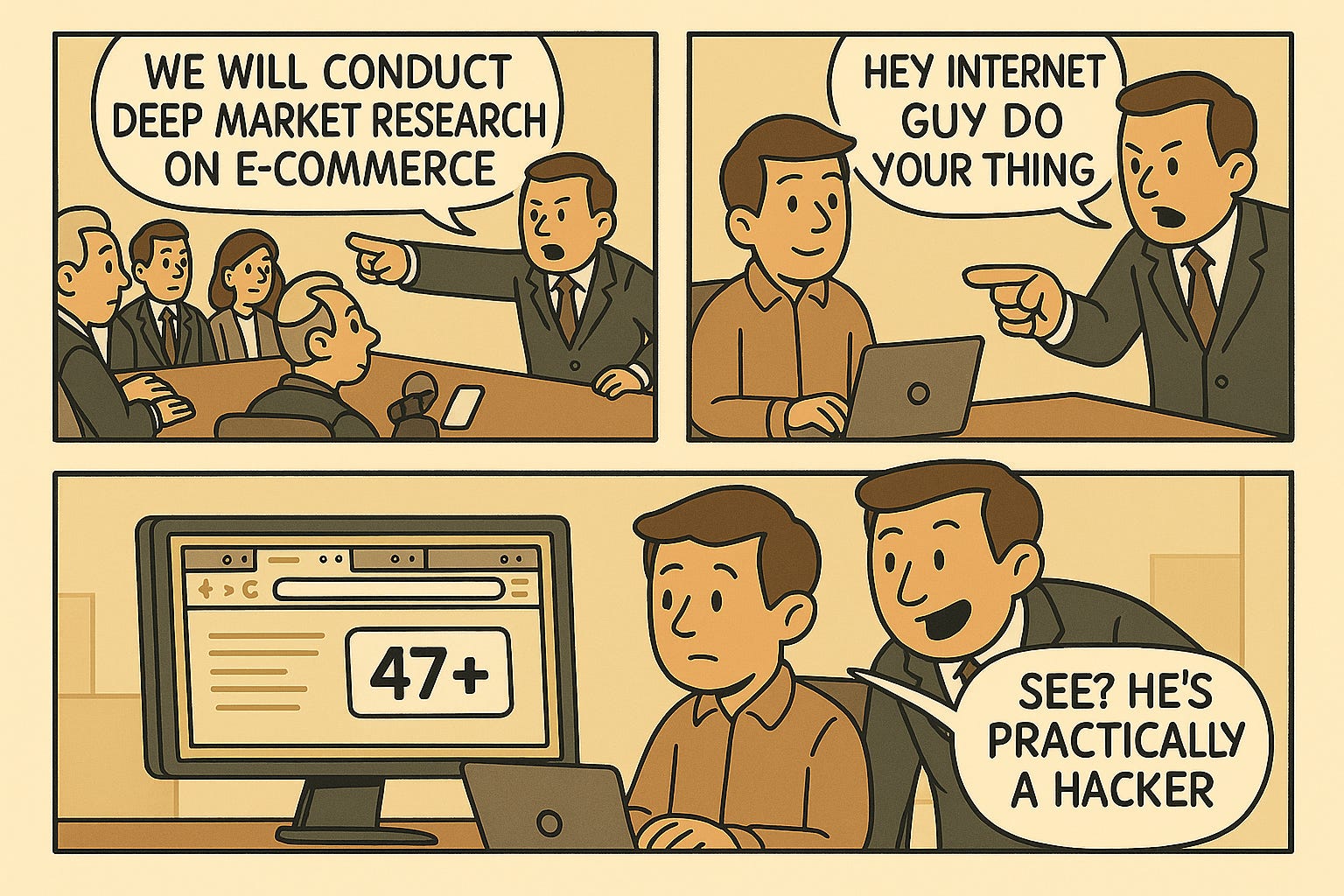
It turned out that being “good at Google” in 2015 was a valuable skill. I wasn’t just finding facts. I was learning how to ask the right questions. How to string together weird combinations of words to unearth a hidden report. How to tell the difference between a real statistic and something a marketing intern made up. I was developing the most important skill of the next decade: navigating digital chaos to find signal in the noise.
Fast forward to today. Right time, right place, right luck. The world changed, but the core skill didn't. I became the guy who kept saying, “Hey this AI stuff is pretty cool, we should look into it”. Now, building AI products is my actual job description. Let me be clear: this is not a story about my genius. It's a story about what happens when you're just persistently curious in a world that's suddenly desperate for curiosity. Sometimes the most strategic career move is just being the first person to volunteer for the weird new thing.
This Is The Part Where You Actually Do Something
Pick the robot you want to hang out with: ChatGPT, Claude, Gemini, or whatever Elon’s calling his these days. Twenty bucks and you're in. That's it. No coding bootcamp, no LinkedIn Learning certificates, just a chat window that sometimes thinks your quarterly revenue is a Pokémon character
Then pick your most soul-crushing daily task and throw it at the AI. First try? The AI will hand you nonsense that makes your cousin’s astrology PowerPoint look rigorous. Celebrate this. That failure? That's your professor. Like learning to cook by burning toast - you need to know what wrong looks like before you can get to right.
Fifteen minutes of daily weirdness morphs into small talk in three months. Small talk becomes collaboration in six. Pretty soon after, collaboration becomes "how did anyone ever do this job without hallucinating robot assistance".
I was the guy in January 2024 who thought GPT was a hipster gym. By December I was automating the most tedious parts of my job. Now I build things that would've been science fiction to last-year me. The secret? I just kept showing up and arguing with robots about formatting.
In ten years AI will be as boring as Microsoft Excel. We'll all be adding "prompt engineer" to our resumes the way our parents appended "proficient in Microsoft Office"— a boring flex for a boring tool. But for the next 24-48 months? A lottery ticket for the curious.
While They're Still Planning, You Could Be Building
Let’s check back on those three executives. They're deep in a cycle of PowerPoints, stakeholder alignment meetings, and governance frameworks. They are building a very sturdy, very expensive fence around a field where the gold rush has already started.
And somewhere inside that fence, someone is quietly digging. Someone in marketing. Someone in finance. Maybe you.
When they finally look up from their plans, they're not going to need another map.
They'll need the person holding the gold.
The window is open. The tools are ready. And everyone's still in meetings about meetings about AI. That's not chaos - that's opportunity.